What is ERSEM?
Background
ERSEM (European Regional Seas Ecosystem Model), has grown in scale and scope in recent years. It addresses biogeochemical and ecological systems in many applications in global regional seas and more recently the global ocean, engaging in a range of problem solving, predictive and impact studies.
Its strength and uniqueness lies in its ability to define relatively complex ecosystems in both pelagic and benthic environments. ERSEM is one of the few marine ecosystem models that uses variable stoichiometry and includes the microbial foodweb, and the major biogeochemical cycles of carbon, nitrogen, phosphorus, and silicate. Recent revisions mean the ERSEM model now includes the iron cycle, calcification, a light model based on inherent optical properties and a more detailed representation of the microbial loop.
ERSEM is an ideal system with which to assess how the changing environment (e.g. light availability, nutrient inputs, temperature, pH) impacts ocean productivity, community size structure, trophic transfer and elemental cycles. ERSEM simulates low to mid trophic levels and can be used to drive fisheries and aquaculture models.
ERSEM is routinely coupled to a wide variety of hydrodynamic models such as GOTM, NEMO and FVCOM using a coupling interface called FABM which enables ERSEM to be run as a simple box model or more realistically in 1-3 dimensional space at scales ranging from local, and coastal via regional to global applications.
Since its original development as a European initiative in the early nineties ERSEM has evolved significantly from a coastal ecosystem model for the North-Sea to a generic tool for ecosystem simulations from shelf seas to the global ocean. It is a UK community model which is also widely used internationally. The development of ERSEM is led by PML and has more than registered 300 users from 30 countries across the world and has appeared in more than 200 peer-reviewed publications.
Ecosystem
The ecosystem in ERSEM is divided into functional types, which are further subdivided by traits such as size. In the pelagic, ERSEM by default distinguishes:
4 types of phytoplankton: diatoms, picophytoplankton, nanophytoplankton, microphytoplankton
3 types of zooplankton: nanoflagellates, microzooplankton, mesozooplankon
bacteria
The benthic system includes:
3 types of infauna: meiofauna, suspension feeders, deposit feeders
2 types of bacteria: aerobic and anaerobic
In addition, ERSEM tracks the concentrations of phosphate, nitrate, ammonium, silicate, iron, oxygen, dissolved inorganic carbon and alkalinity in the pelagic and in sediment porewaters. It includes several classes of particulate and dissolved organic matter in pelagic and sediment. A carbonate system module calculates pH and calcium carbonate saturation.
FABM also makes it easy to customise the default set of functional types described above, and to combine ERSEM with modules representing other parts of the ecosystem, including fish communities, shellfish, seagrass meadows and spectraly resolved irradiance.
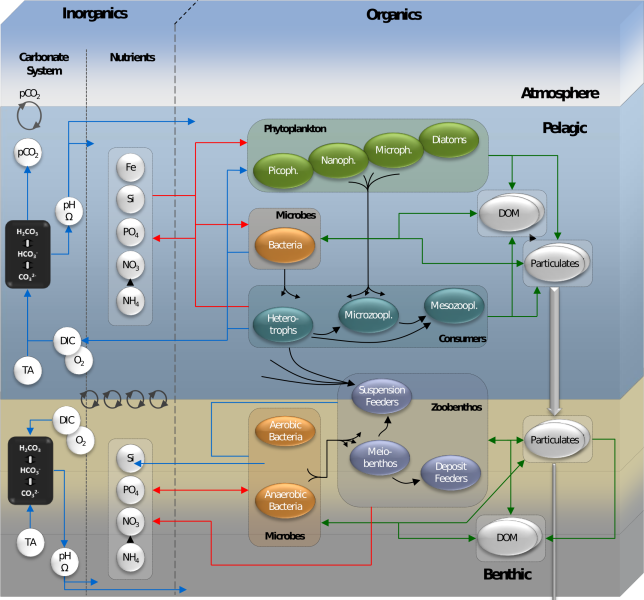
ERSEM schematic